
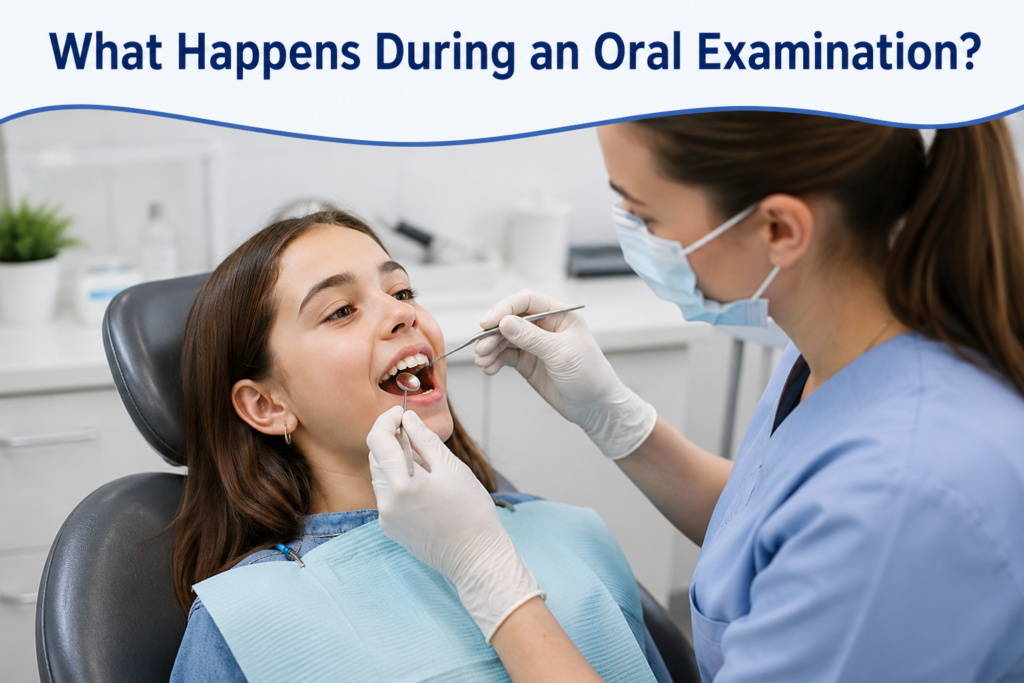
An oral examination is a clinical assessment of your child’s entire mouth, not just their teeth. It includes a review of the gums, tongue, palate, jaw alignment, bite development, and soft tissues, as well as an evaluation of any new symptoms or changes since the last visit.
These aren’t just “cavity checks.” Each exam builds a developmental picture of your child’s oral health over time.
Key Terms of Pediatric Oral Exam
- Calculus (Tartar): Hardened mineral deposits on teeth. Removed only by professional cleaning.
- Caries: Clinical term for cavities or tooth decay.
- Crossbite: Upper teeth that close inside the lower teeth do not correct on their own.
- Gingivitis: Early gum inflammation caused by plaque buildup. Fully reversible with care.
- Malocclusion: Irregular contact between upper and lower teeth, overbites, underbites, crowding.
- Prophylaxis: Professional dental cleaning.
- Sealant: Thin protective coating applied to back molar grooves to prevent cavities.
What the Dentist Asks Before Opening Your Child’s Mouth
Before the doctor examines a single tooth, he/she talks with you. This conversation gives him critical context that no X-ray can provide.
He/She may ask about:
- Any new symptoms, pain, sensitivity, or discomfort while chewing
- Changes in your child’s eating habits or sleep patterns
- Oral habits like thumb-sucking, pacifier use, or nail-biting
- Current brushing and flossing routine at home
- Medical history updates, new medications, recent illnesses, or health changes
- Feeding history for younger children, prolonged bottle use, juice consumption, or nighttime nursing
This review shapes what the dentist focuses on during the physical exam. A child who’s been thumb-sucking, for example, will get a more careful look at bite alignment. A child on a new antibiotic may need an assessment for soft-tissue changes.
The Dentist Checks Your Child’s Face: Here’s What They’re Looking For
The exam begins outside the mouth. The dentist checks the head, neck, and facial structures before looking inside:
- Face and jaw symmetry, any unusual swelling or asymmetry
- Neck lymph node enlargement can signal infection
- Jaw joint (TMJ), checked for clicking or limited movement
- Lips and skin around the mouth, sores, or dryness
Many issues inside the mouth show visible clues on the outside first.
The dentist checks what’s inside the mouth before looking at the teeth.
Soft tissues are examined before individual teeth. This includes:
Gums: Healthy gums are firm and pink. Redness, swelling, or bleeding are early signs of gingivitis, which is reversible when caught early.
Tongue: Checked on top, underneath, and along the sides for spots, lesions, or restricted movement (tongue tie).
Palate: Both the hard and soft palate are examined for unusual coloration, bumps, or structural concerns.
Inner Cheeks and Floor of Mouth: Checked for sores, fluid-filled bumps, or abnormal tissue.
In What Ways Does The Dentist Examine Each Tooth?
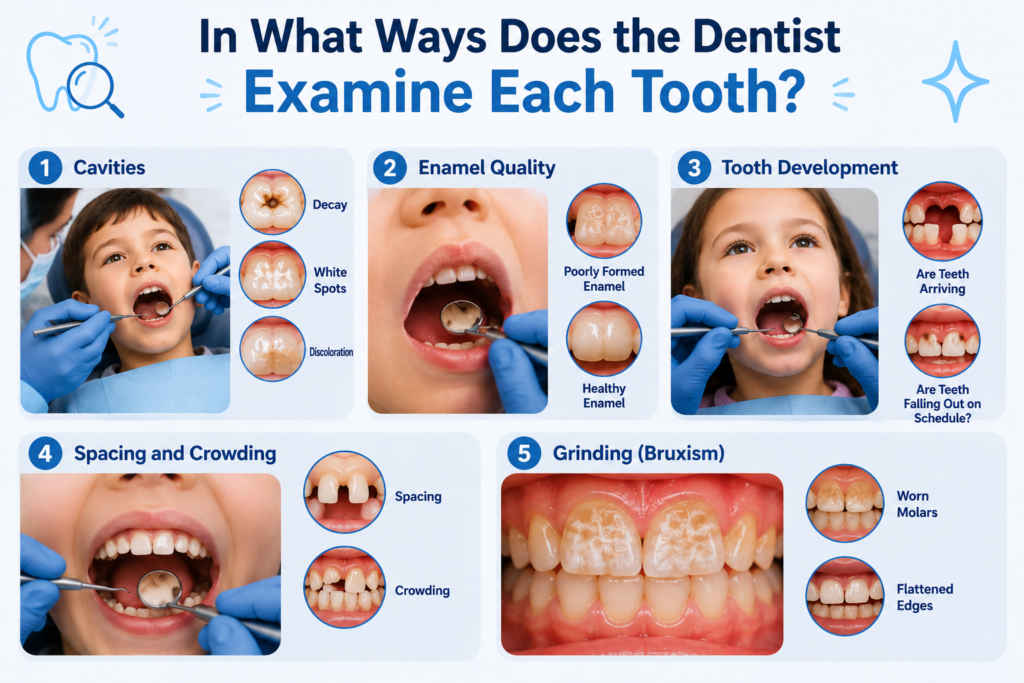
Using a small probe (dental explorer) and a mirror, the dentist checks every tooth for:
- Cavities: early decay shows as white spots, soft areas, or discoloration
- Enamel quality: poorly formed enamel is more vulnerable to decay
- Tooth development: Are teeth arriving and falling out on schedule?
- Spacing and crowding: affect how permanent teeth will come in
- Grinding (bruxism): and worn molars suggest nighttime grinding
What Does the Dentist Look for Beyond the Teeth?
Teeth sit in gum tissue and bone. The dentist checks:
- Gum attachment to each tooth, recession, or detachment is noted
- Early gum inflammation, pockets, puffiness, or bleeding
- Eruption status, whether unerupted teeth are progressing normally
Gingivitis in children is common and fully reversible with better brushing, flossing, and professional cleaning.
Do Dentists Check How Your Child’s Teeth Come Together?
Bite assessment is one of the most important parts of a pediatric exam. The dentist evaluates:
- Overjet: how far the upper front teeth protrude forward
- Overbite: how much the upper teeth overlap the lower teeth vertically
- Crossbite: upper teeth sitting inside lower teeth when biting down
- Underbite: the lower jaw protrudes in front of the upper jaw
- Midline: whether the upper and lower centers align
- Spacing: room available for permanent teeth
The American Association of Orthodontists recommends that all children be screened by an orthodontist at age 7. By this age, a child has enough permanent teeth for the orthodontist to detect and potentially treat jaw or teeth alignment issues. At Smiley Faces Dental, pediatric and orthodontic care are under one roof, so alignment concerns are caught and addressed without a separate referral. [2]
What Do X-Rays Show That a Visual Exam Cannot?
X-rays are taken only when there’s a clinical reason. They reveal:
- Cavities forming between teeth, invisible to the naked eye
- Root development beneath the gumline
- Unerupted permanent tooth positioning
- Bone levels and support structures
- Missing or extra teeth
The AAPD suggests varying X-ray frequency based on risk; children at high cavity risk may need bitewing X-rays every 6–12 months, while those at low risk may only need them every 12–24 months. Dentists follow the ALARA principle, meaning X-rays are only recommended when the diagnostic benefit clearly outweighs the minimal radiation risk. [3]
How Long Does a Child’s Oral Examination Take?
| Child’s Age | Typical Visit Length |
|---|---|
| Ages 1–3 | 20–30 minutes |
| Ages 4–7 | 30–45 minutes |
| Ages 8–12 | 45–60 minutes |
| Ages 13–18 | 45–60 minutes |
First visits tend to run slightly longer because they include a thorough intake history. Follow-up visits are generally faster when no new concerns are identified.
Pediatric Oral Exams Check What Regular Exams Might Not?
Pediatric oral examinations are specifically structured for developing mouths. Beyond the standard adult exam, a pediatric exam includes:
- Eruption tracking: monitoring the sequence and timing of primary and permanent tooth emergence
- Habit assessment: thumb-sucking, pacifier use, nail-biting, and their oral effects
- Jaw growth monitoring: identifying growth patterns that benefit from early intervention
- Caries risk classification: categorizing each child’s individual cavity risk and tailoring prevention accordingly
- Developmental screening: watching for signs of delayed tooth development or structural abnormalities
Because children’s mouths change rapidly between ages two and eighteen, each exam is evaluated against an age-specific developmental baseline, not a single adult standard.
Frequently Asked Questions
1. How often should your child have an oral examination?
Every six months is the recommendation. Children at higher cavity risk may be recommended to come in more frequently, every three to four months.
2. What age should your child have their first oral exam?
The AAPD and the American Dental Association recommend that a child’s first dental visit take place within 6 months of the eruption of the first primary tooth and no later than 12 months of age. Early exams establish a dental home, build comfort, and catch developmental concerns early. [1]
3. Does a dental exam hurt?
No. An oral examination is a visual and tactile assessment, with no drilling and no injections. The dental explorer used to check teeth may feel slightly uncomfortable in sensitive areas, but it should not be painful.
4. What if your child won’t open their mouth?
For very young children (under three), the doctor uses a knee-to-knee exam technique, the child lies across the parent’s lap, keeping the child close to you while allowing a clear view of the mouth.
5. Do X-rays happen at every visit?
No. X-rays are only taken when there is a clinical reason, a specific area of concern, a cavity risk assessment, or a developmental question that requires imaging to answer.
6. What is the dentist looking for when they check your child’s bite?
Bite assessment checks overjet (forward protrusion), overbite (vertical overlap), crossbite, underbite, midline alignment, and spacing between teeth. Problems caught before age eight or nine are often easier to correct with early orthodontic intervention.
Schedule Your Child’s Oral Exam at Smiley Faces Dental
Smiley Faces Dental serves children ages 2 to 18 in Corona, NY. Dr. Alex Gor, DDS, performs comprehensive oral examinations as part of every routine visit, including teeth, gums, bite development, soft tissue screening, and orthodontic assessment, all under one roof.
Call us or schedule your child’s next exam.
We’re located at 35-38 Junction Blvd., Suite B, Corona, NY 11368. Open Monday – Saturday, 10:00 AM to 5:00 PM.
Sources
- American Academy of Pediatric Dentistry & American Dental Association — First dental visit recommendation — https://pmc.ncbi.nlm.nih.gov/articles/PMC9983582/
- American Association of Orthodontists — Orthodontic screening by age 7 — https://aaoinfo.org/whats-trending/early-orthodontic-care-may-help-you-avoid-costly-treatments/
- AAPD — X-ray frequency guidelines / ALARA principle — https://mydentaladvocate.com/pediatric-dental-x-ray-guidelines/