
If your child brushes their teeth two times a day, it means that you have a healthy habit. You try to avoid giving too much candy, sweet drinks, etc. You try to do everything that can be done, but still, the dentist tells you that there is a cavity requiring children’s dental fillings. It is very frustrating because you were always taking care of your kids’ teeth properly. Many people don’t understand that there is one more thing connected with cavities apart from sweets: xylitol bacteria.
What Is Xylitol?
Xylitol is a naturally occurring sugar alcohol present in trace amounts in fruits, vegetables, and birch trees. Xylitol is very similar in appearance and taste to sugar; however, its molecular composition is completely different. This distinction is precisely why it can prove helpful in maintaining good oral hygiene in children.
Xylitol is not fermentable by the Streptococcus mutans bacteria, which cause tooth decay. As soon as the cavity-causing bacteria start feeding on xylitol, they are unable to metabolize it, resulting in their inability to grow and reproduce.
Is Xylitol Safe for Toddlers? Can Babies Have Xylitol?
Yes, Xylitol is safe for kids when we use it in the right way and the right amount. For children under 4 years old, we should not give them Xylitol gum because it can be a choking hazard. Xylitol wipes, Xylitol gels, and Xylitol toothpaste are all made for this age group. The important time is from 6 months to 2 years old when the bacteria that causes cavities first starts to grow in a child’s mouth.
Using Xylitol wipes on the gums when the teeth are coming in is one of the things we can do to help prevent cavities in kids. When we use Xylitol in the amounts, it does not hurt toddlers. We just need to remember one thing: Xylitol is very bad for dogs, so we need to keep all Xylitol products where pets cannot get to them.
How Xylitol Prevents Cavities in Kids: The Mechanism
It is necessary to have a general understanding of the process behind cavities before discussing how xylitol works to prevent cavities in children.
The bacteria Streptococcus mutans consume fermentable sugars to generate acid, which then causes erosion in the tooth enamel. More exposure to sugar, whether through food intake or other means like juice and breast milk after teeth emerge, results in a higher probability of causing erosion.
Two mechanisms are responsible for the efficacy of xylitol in cavity prevention:
1. It starves the bacteria
Streptococcus mutans ingests xylitol, mistaking it for glucose, but cannot metabolize it. Bacteria expend energy metabolizing xylitol without creating acid or absorbing nutrients from it. As a result, bacteria that continuously ingest xylitol begin to produce less acid, lose their “stickiness,” and find it harder to adhere to the surface of teeth.
2. It reduces bacterial transmission
Xylitol users showed a decrease in the level of cavity-forming bacteria in the oral flora and had much lower chances of transmitting the highest levels of Streptococcus mutans to their babies during the period when teeth appear. “Maternal transmission” is the most important part of all studies done in this area.
The effect of using xylitol, apart from reducing cavities, is that it changes the bacterial microflora in the whole mouth.
What the Science Actually Says
There are numerous studies supporting the use of xylitol for dental purposes in children. It would be right to give parents an unbiased understanding of the benefits xylitol may provide.
What is well-established:
- A landmark five-year study in Belize (often called the Ylivieska trials) showed a 35–60% reduction in new cavities among school-age children given xylitol candy versus a control group.
- A Cochrane systematic review found “some evidence” supporting xylitol in reducing cavities in primary (baby) teeth, though researchers noted the need for more standardized study designs.
- The American Academy of Pediatric Dentistry (AAPD) includes xylitol in its clinical guidelines as a caries-prevention strategy.
Xylitol vs. Fluoride: Does Your Child Need Both?
One of the most frequent questions from parents at our clinic is whether or not these work differently, and here’s an honest response: Yes, and in most cases, both are necessary.
| Category | Xylitol | Fluoride |
|---|---|---|
| How it works | Starves acid-producing bacteria (S. mutans); they absorb xylitol but can’t metabolize it, so they weaken and decline | Remineralizes and hardens enamel that has already been softened by acid, rebuilding the tooth’s protective layer |
| When it works | Upstream, before acid ever forms. Works continuously with regular use throughout the day | After an acid attack, it is most effective once the enamel has already been exposed to bacterial acid |
| Primary role | Reduces the number and strength of cavity-causing bacteria in the mouth | Strengthens and repairs enamel so it resists future acid damage |
| Simple analogy | Reduces the number of battles your child’s teeth have to fight | Armor that protects teeth during every battle |
| Best formats | Gum, lollipops, wipes, toothpaste 4–8g daily across 2–3 exposures | Toothpaste, fluoride varnish at cleanings, fluoridated water |
| Replaces the other? | No, they work through different mechanisms and are most effective together | |
These two procedures go hand in hand rather than compete with each other. For families curious about fluoride use, our complete fluoride guide for kids covers safety, dosing by age, and what’s evidence-based. In the vast majority of pediatric dental guidelines, both are recommended as part of a complete preventive pediatric dental care plan for children at higher cavity risk. especially children under six years old, children who have experienced decayed teeth before, or children on a high-sugar-intake diet.
The Best Xylitol Products for Kids

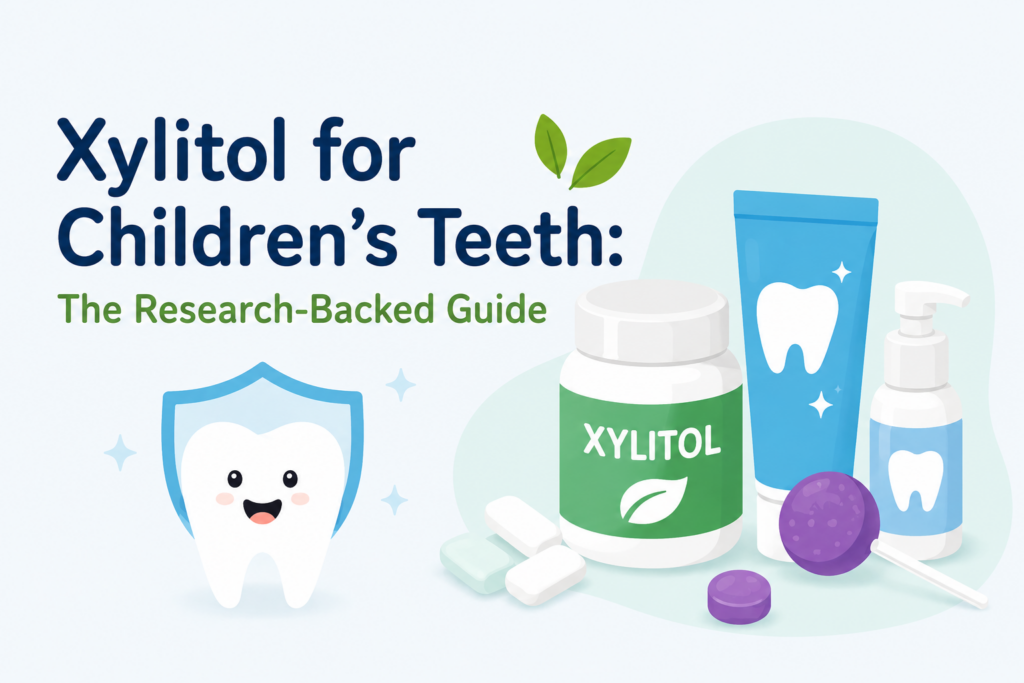
In selecting the best xylitol products for children, the following three criteria should be fulfilled: first of all, xylitol has to be the primary sweetener on the label, the recommended dosage needs to be enough for therapeutic purposes, and the product has to fit the child’s age category.
Xylitol gum (for ages 4 and up). Gum happens to be the most researched means of administering xylitol. The recommended products include Xylichew, Spry Kids Gum, and Epic Xylitol Gum with 1-1.5 grams per piece. In addition, chewing gum encourages salivation that acts as an acid buffer in the mouth. Not recommended for kids below 4 years.
Xylitol wipes or gel (for infants/toddlers). When children are still too young to be able to chew gum or brush their teeth, the application of xylitol wipes (e.g., Spiffies) or xylitol gel on their gums will help prevent early bacterial colonization. This will be especially helpful for those within the “window of infectivity,” which ranges from 6 months to 2 years of age.
Xylitol toothpaste. Numerous toothpastes designed for kids’ fluoride toothpastes also contain xylitol, which allows for easy integration into your current regimen. Toothpastes such as Tom’s of Maine Children’s and Spry Kids provide a clinically significant amount of fluoride and xylitol in one product.
Xylitol hard candy and lollipops, such as Zollipops and YumEarth Organic Pops, are slow-dissolving candies that sit against your teeth. This solution works best for older children who enjoy chewing on these kinds of treats.
Products to avoid: Those with xylitol appearing way below other ingredients, such as sorbitol or sucrose, are not very likely to have a significant amount of xylitol. Consistent prevention is important because untreated early decay can eventually require treatments like dental crowns in children.
How Much Xylitol Does a Child Actually Need?
One place where parents might fall short is proper dosing. The majority of studies concerning xylitol in reducing cavities among children have established that a daily dosage range of 4 to 8 grams has been therapeutically effective.
In this case, frequency is more important than total volume. A single heavy dose is not as effective as multiple lighter doses distributed throughout the day.
An example of an easy-to-follow timetable for a school-going child could be:
- Xylitol toothpaste – Morning tooth brushing
- Xylitol gum – Post-lunch snack
- Xylitol candy or Xylitol gum – Evening meal
- Xylitol toothpaste – Before going to bed
This easily meets the daily intake target of 4-6 grams without disrupting your schedule too much.
What About Xylitol and Baby Teeth?
There is an immense importance associated with baby teeth that goes unnoticed by most parents. Protecting baby teeth early can also reduce the likelihood of advanced procedures such as pulp therapy caused by severe decay. This biological environment for permanent teeth depends largely on how the baby teeth are cared for.
For families focused on building strong early dental habits, xylitol is one of the most impactful tools available precisely because it works at the level of bacterial colonization, during the window when those habits are first being established.
Starting xylitol early (even before teeth erupt, via maternal use or infant wipes) is supported by some of the strongest evidence in the field.
FAQ
1. If a product is sweetened with xylitol, is it safe for my child to eat freely?
Xylitol products can help prevent cavities, but they should be used in moderation since too much may cause digestive discomfort, especially in young children. They also do not treat or reverse existing cavities.
2. Does any amount of xylitol in a product help protect teeth?
Xylitol helps protect teeth only when the dose is high enough. Products work best when xylitol is listed as a top ingredient and provides at least 1 gram per use.
3. Can xylitol replace fluoride in my child’s routine?
Xylitol cannot replace fluoride because they protect teeth in different ways: xylitol reduces harmful bacteria, while fluoride strengthens enamel.
4. Will my child actually use xylitol products, or will they resist the taste?
Many children like xylitol’s mild taste, and its variety of forms makes it easier to find one they will use.
A Note from Our Team at Smiley Faces Dental
At our practice in Corona, NY, we talk to parents every day about building a layered approach to cavity prevention, one that goes beyond brushing twice a day. Xylitol is a conversation we love having because the research is solid and the barrier to entry is low. A piece of gum. A lollipop. A smear of toothpaste.
For children with a history of decay, siblings with a history of cavities, or families with high sugar intake, we often recommend adding xylitol products explicitly to the daily routine, alongside professional cleanings every six months, dental sealants where appropriate, and occasionally Silver Diamine Fluoride (SDF) for children with active early decay.
If you’re wondering whether xylitol makes sense for your child specifically, or which products to start with, that’s exactly the kind of conversation we’re here for.
📞 Call us or visit Smiley Faces Dental to schedule a visit.