
When parents hear that their child has a cavity, they often start researching treatment options right away. That’s when many come across two terms: SDF vs. sedation for kids.
The problem is that parents often compare them as if they do the same thing.
They don’t.
This is one of the biggest misunderstandings pediatric dentists see every day. SDF and sedation solve completely different problems, and understanding the difference can help you make a better decision for your child’s oral health.
If you’re wondering, “SDF vs sedation dentistry for kids, which is better?”, the answer depends on your child’s cavity, age, comfort level, and treatment needs.
The Biggest Misunderstanding Parents Have About SDF and Sedation
Many parents think they have to choose between SDF and sedation, as if they are two different ways to treat the same cavity.
They aren’t.
The simplest way to understand the difference is this:
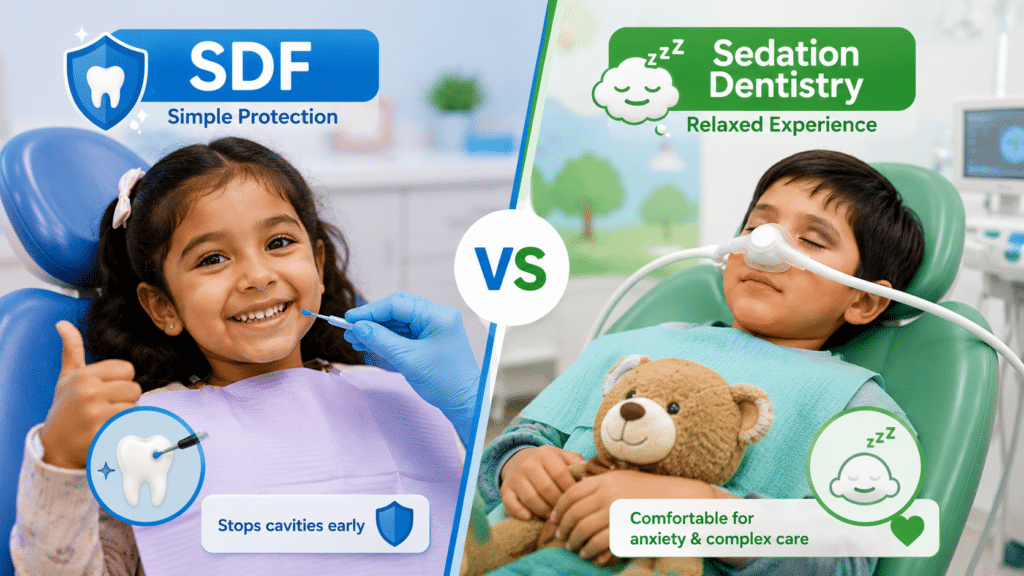
SDF helps treat the cavity. Sedation helps your child stay calm and comfortable during treatment.
SDF is used to help stop a cavity from getting worse. Sedation does not treat the cavity itself. Instead, it helps children who are very young, anxious, or unable to sit through treatment comfortably.
For example, if your child has a small cavity, a dentist may recommend SDF to help manage it. If your child needs fillings, crowns, or several services and has difficulty sitting still, sedation may be recommended to make treatment easier and less stressful.
In some cases, a child may only need SDF. In other cases, sedation may be needed so treatment can be completed safely. Some children may even benefit from both at different stages of care.
That’s why the real question isn’t whether SDF is better than sedation. The real question is what your child needs based on their cavity and treatment plan.
A Simple Way to Treat Kids’ Cavities Without Drilling
Many parents are surprised to learn that not every cavity needs to be treated with a drill right away.
In some cases, a pediatric dentist may recommend Silver Diamine Fluoride (SDF), a liquid that is applied directly to the affected tooth. The goal is to help stop the cavity from getting worse and protect the tooth from further damage.
Because the treatment is quick and does not involve drilling, needles, or numbing shots, it can be a good option for young children who may not be ready for more involved dental treatment.
SDF is often recommended for:
- Toddlers and preschoolers
- Children who feel nervous at the dentist
- Children who have trouble sitting through treatment
- Early cavities that have not become severe
However, it’s important to understand what SDF can and cannot do.
SDF can help stop a cavity from growing, but it does not repair the part of the tooth that has already been damaged. If the cavity is large or continues to cause problems, additional treatment may still be needed later.
One thing parents often notice after SDF treatment is that the treated area can turn dark black. While this can be surprising, it is a normal part of how the treatment works.
The Treatment That Doesn’t Fix Cavities But Makes Treatment Possible
Many parents think sedation is a treatment for cavities, but that’s not actually what it does. Sedation does not fix a cavity or remove decay. Instead, it helps children stay calm, comfortable, and relaxed while the dentist performs the treatment they need. This can be especially helpful for very young children, children who feel anxious about dental visits, or children who need a lot of dental work completed in one appointment.
Depending on the child’s needs, a pediatric dentist may recommend:
- General anesthesia
The purpose of sedation is to help a child safely receive treatment when anxiety, age, or extensive dental needs make treatment difficult.
Learn more about sedation dentistry for kids in Corona, NY, and when it may be recommended.
Could This Cavity Be Stopped Without Sedation?
If a cavity is found early, your child may not need sedation at all. A pediatric dentist may be able to use SDF to help stop the cavity from getting worse before more involved treatment becomes necessary.
This is one of the biggest reasons regular dental checkups matter. The earlier a cavity is found, the more treatment options are usually available.
SDF may be a good option when:
- The cavity is still small
- The child is very young
- The child feels nervous about dental treatment
- Parents want to avoid drilling if possible
However, SDF is not the right choice for every cavity. If the decay is deep, causing pain, or affecting a large part of the tooth, other treatment may be needed.
The key takeaway is simple: the earlier a cavity is treated, the better the chance of managing it without sedation or more extensive dental work.
The Moment SDF Stops Being Enough
SDF may not be the best option when a cavity is large, deep, painful, or affecting multiple teeth.
As decay progresses, the tooth may require treatment that SDF cannot provide.
Signs that more comprehensive care may be needed include:
- Tooth pain
- Swelling
- Deep decay
- Multiple cavities
- Difficulty eating due to discomfort
In these situations, your pediatric dentist may recommend restorative treatment, and, depending on the child’s age and cooperation level, sedation may also be discussed.
Real-Life Scenarios: Which Option Would Most Pediatric Dentists Choose?
A Nervous 3-Year-Old With One Small Cavity
SDF may be considered because it can be applied quickly without drilling.
A 5-Year-Old With Several Cavities
Restorative treatment may be necessary, and sedation could help complete care comfortably.
A Toddler Who Refuses Treatment
Depending on the severity of decay, SDF may provide a temporary solution while the child matures.
A Child With Extensive Tooth Decay
Sedation may allow the dentist to complete all necessary treatment safely and efficiently.
Every child is different, which is why treatment recommendations should always be personalized.
SDF vs Sedation Dentistry for Kids: Side-by-Side Comparison
| Feature | SDF | Sedation Dentistry |
|---|---|---|
| Purpose | Helps stop cavity progression | Helps children stay comfortable during treatment |
| Treats cavities directly | Yes | No |
| Requires drilling | Usually no | Depends on treatment |
| Requires injections | No | Sometimes |
| Best for | Early cavities | Extensive treatment for anxiety |
| Restores damaged teeth | No | No |
| Helps anxious children | Sometimes | Yes |
What Parents Like Most About SDF (And What They Usually Don’t)
Benefits
- Fast treatment
- No drilling
- No injections
- Comfortable for many children
- Can help manage early decay
Limitation
The most common concern is that the treated cavity typically turns dark.
The dark color is a common effect of SDF treatment and often occurs in areas affected by decay.
Why Some Children Benefit More From Sedation Than Parents Expect
Many parents feel worried when sedation is mentioned. That’s understandable. But for some children, sedation can make dental treatment much easier and less stressful.
If a child is very nervous, has trouble sitting still, or needs a lot of dental work, sedation can help them stay calm and comfortable during the visit. It can also allow the dentist to complete more treatment in fewer appointments, which means less disruption for both the child and the family.
The decision to use sedation is not based on age alone. It depends on your child’s needs, how much treatment is required, and what will help them have the safest and most comfortable experience possible. The goal is simple: to help your child get the dental care they need without unnecessary stress or fear.
Can a Child Need Both SDF and Sedation at Different Times?
Many parents think they have to choose between SDF and sedation, but that’s not always the case. A child may benefit from both at different times, depending on their dental needs.
For example, a dentist may use SDF to help stop a small cavity from getting worse. Later, if the tooth needs more treatment, sedation may be recommended to help the child stay comfortable during the procedure.
The opposite can happen, too. A child who receives treatment with sedation may still have other teeth that can be managed with SDF in the future.
The important thing to understand is that SDF and sedation are not competing options. They are used for different reasons, and sometimes both can play a role in helping a child maintain a healthy smile.
Frequently Asked Questions
1. Is SDF safer than sedation?
Both are commonly used in pediatric dentistry when appropriate. They serve different purposes and should not be viewed as direct replacements for one another.
2. Can SDF completely replace fillings?
Not always. Some cavities may still require restorative treatment.
3. Does SDF hurt?
No. The application is typically quick and comfortable.
4. Does sedation fix cavities?
No. Sedation helps children receive treatment. The dental procedure itself addresses the cavity.
5. Will every child with cavities need sedation?
No. Many children can receive treatment without sedation, depending on the situation.
6. Do baby teeth need fillings?
In many cases, yes. Untreated decay in baby teeth can continue to progress and affect oral health.
Serving Families Across Queens
At Smiley Faces Dental, we help families in Corona, NY, Junction Blvd, Near Elmhurst, Jackson Heights, and surrounding Queens neighborhoods understand all available treatment options before making decisions.
Our goal is simple: provide the right treatment for the right child at the right time.
If you’re unsure whether your child may benefit from SDF, sedation, or another treatment option, a pediatric dental evaluation can help determine the safest and most effective approach based on your child’s needs.