

Dentists use sedation dentistry to help anxious children and those undergoing complex procedures stay comfortable and cooperative throughout treatment. It’s not about putting your child to sleep. In most cases, it’s a mild oral medication or a gentle gas that helps them stay calm while staying awake. Sedation Dentistry for Kids in Corona, NY.
What Is Sedation Dentistry for Children?
Dentists use sedation dentistry to help children stay calm, relaxed, and cooperative during dental procedures. It does not necessarily mean unconsciousness. Most pediatric sedation helps children stay conscious but deeply relaxed during treatment. They can respond to the dentist, remain aware of their surroundings, and feel little to no anxiety or discomfort.
Dental sedation is distinct from general anesthesia, which renders a patient fully unconscious and requires a hospital setting. Nitrous oxide and oral sedation help children stay calm and comfortable during treatment while remaining awake.
Is Sedation Dentistry Safe for Kids?
Yes, when performed by a trained pediatric dentist following established safety protocols, sedation dentistry is safe for children. The American Academy of Pediatric Dentistry (AAPD) publishes clinical guidelines for pediatric sedation that include monitoring requirements, dosing standards, emergency preparedness, and post-procedure care. [1]
Our trained dental team continuously monitors vital signs, including heart rate, oxygen levels, and breathing, during every sedation appointment. The dentist determines the medication dosage using your child’s weight and medical history.
Types of Dental Sedation for Children
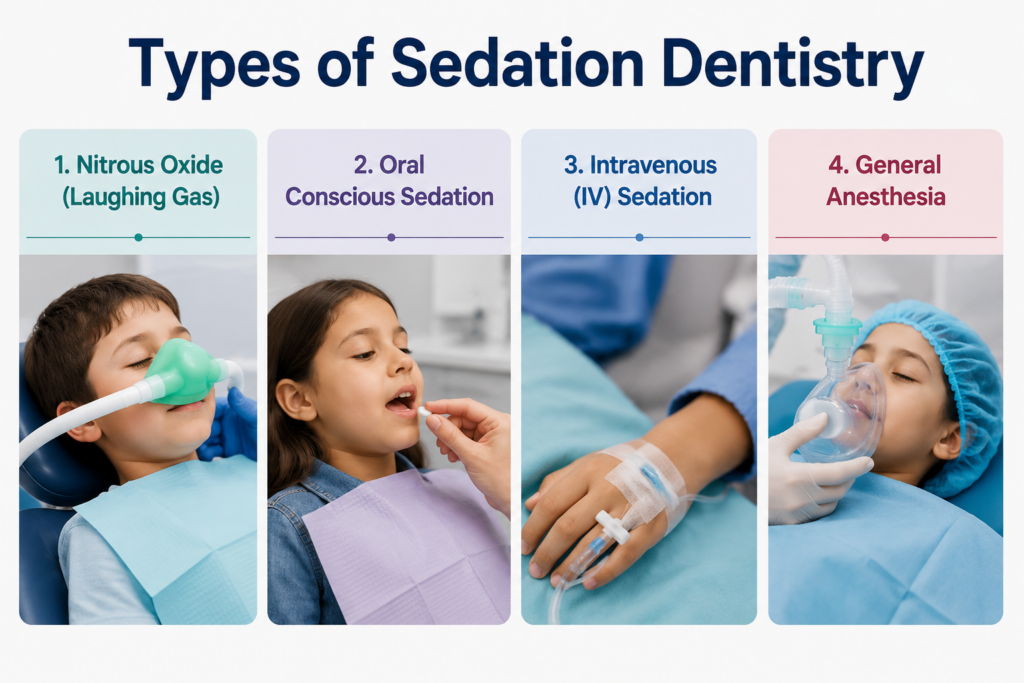
There are four types of dental sedation used in pediatric dentistry. The right option depends on the child’s age, anxiety level, health history, and the complexity of the procedure.
Nitrous Oxide (Laughing Gas)
The child breathes a mix of nitrous oxide and oxygen through a small nose mask. It produces a relaxed feeling within minutes while the child stays fully awake. Effects clear within 5 minutes of removing the mask, no recovery time, no restrictions on food or activity afterward.
Best for: Mild anxiety, short procedures, children ages 3 and up.
Oral Sedation
The dentist administers oral sedation to the child about 30 to 45 minutes before treatment. The child becomes deeply relaxed and may doze, but can be easily woken. Breathing stays normal throughout. A parent must stay at the office and take the child home afterward. Recovery takes 2-4 hours.
Best for: Moderate to severe anxiety, longer procedures, young children who can’t cooperate with nitrous oxide alone.
IV Sedation
Medication delivered directly into the bloodstream produces a stronger, faster effect. The child is semi-conscious, relaxed, but still able to respond. Closer monitoring is required throughout. Recovery takes 4-6 hours.
Best for: High anxiety, extensive treatment, older children who haven’t responded to lighter sedation.
General Anesthesia
Administered in a hospital or surgical center, not a dental office. The child is fully unconscious. Reserved for the most complex cases.
Best for: Children under 3, significant special needs, or extensive oral surgery.
Sedation Type Comparison
| Type | Awareness | Recovery Time | Best For | Available at Smiley Faces |
|---|---|---|---|---|
| Nitrous Oxide | Fully awake, relaxed | 5–10 minutes | Mild anxiety, short visits | ✓ Yes |
| Oral Sedation | Drowsy, may doze | 2–4 hours | Moderate–severe anxiety | ✓ Yes |
| IV Sedation | Semi-conscious | 4–6 hours | High anxiety, longer procedures | ✓ Yes |
| General Anesthesia | Fully unconscious | Hospital discharge | Complex cases, under age 3 | Referral |
When Does a Child Need Sedation Dentistry?
Sedation isn’t recommended for every child or every visit. Dentists use it when treatment can’t be completed safely or comfortably without it.
Dental Anxiety
Dental fear affects an estimated 9–20% of children and is one of the most common reasons kids avoid care. When anxiety makes it impossible to hold still or cooperate, even with a gentle, experienced dentist, sedation allows treatment to happen without a frightening experience. [2]
Special Needs and Sensory Sensitivities
Children with autism or sensory processing differences often find the dental environment overwhelming. Sedation helps dentists complete treatment safely when a child genuinely can’t tolerate the procedure any other way.
Extensive Treatment
When a child needs several fillings, extractions, or multiple procedures at once, sedation allows everything to be completed in one appointment, fewer visits, and less stress overall.
Very Young Children
Children under 5 aren’t being difficult when they can’t sit still. Their brains simply aren’t developed enough yet to follow dental instructions for an extended time. Oral sedation is commonly used for toddlers and preschoolers who need restorative treatment. [3]
Prepare Your Child for Sedation Dentistry
Preparation reduces risk and helps the appointment go smoothly. Follow every instruction provided by the dental office; they are specific to your child’s sedation type and health history.
Fasting Rules Before Sedation
Fasting requirements depend on the type of sedation:
| Sedation Type | No Solid Food | No Clear Liquids |
|---|---|---|
| Nitrous Oxide | No restriction | No restriction |
| Oral Sedation | 6 hours before | 2 hours before |
| IV Sedation | 8 hours before | 2 hours before |
Always follow the specific instructions given at your pre-sedation consultation. These rules exist because sedation can suppress protective reflexes, and fasting reduces the risk of aspiration.
What to Tell Your Child Beforehand
Keep language calm and simple. Tell your child that the dentist will give them medicine to help them feel calm and sleepy. Reassure them that you’ll stay nearby and that they’ll feel better after the procedure.
Avoid detailed descriptions of the procedure. Anxiety is contagious; if you’re calm, they have a better chance of being calm too.
What Happens After Dental Sedation?
Recovery Timeline by Sedation Type
Recovery varies significantly depending on which type of sedation was used:
Nitrous oxide: No recovery period. Children can resume normal activity immediately after the appointment.
Oral sedation: Children should rest at home for the remainder of the day. No school, no vigorous activity, no unsupervised time. Drowsiness and mild unsteadiness are normal for 2–4 hours.
IV sedation: Full rest required for the day. Parents should closely monitor their child during recovery, and another adult should stay at home to help if needed.
Warning Signs to Watch For After Sedation
Contact the dental office immediately if your child experiences any of the following after sedation: difficulty breathing or unusual breathing patterns, vomiting that won’t stop, extreme difficulty waking, fever, or unusual skin color (pale, blue-tinged, or flushed). These are rare but require prompt attention.
Frequently Asked Questions About Sedation Dentistry for Kids
1. What is sedation dentistry for children?
Sedation dentistry uses safe, controlled medication to help children stay calm and cooperative during dental treatment. Most forms of pediatric sedation keep the child awake but deeply relaxed, not unconscious.
2. Can a toddler or 2-year-old receive dental sedation?
Yes. Oral sedation is commonly used for children as young as 2 when restorative treatment is needed, and the child cannot cooperate. Dosing is calculated by weight, and the child is monitored throughout the procedure.
3. Will my child be asleep during sedation?
It depends on the type. With nitrous oxide, the child is fully awake. With oral sedation, the child is drowsy and may doze, but can be roused. Only general anesthesia produces full unconsciousness, and that takes place in a hospital, not a dental office.
4. How long does dental sedation last?
Nitrous oxide clears in 5–10 minutes. Oral sedation effects last 2–4 hours. IV sedation takes 4–6 hours to fully clear. Your child will need direct supervision during this time.
5. What should my child eat before sedation?
For nitrous oxide, there are no food restrictions. For oral or IV sedation, children must fast, typically 6–8 hours for solid food and 2 hours for clear liquids. Your dentist will provide specific fasting instructions at the pre-sedation visit.
6. What are the side effects of dental sedation in children?
Common, temporary side effects include drowsiness, mild nausea, dizziness, and unsteadiness. Serious side effects are rare when sedation is administered by a trained provider with proper monitoring equipment in place.
7. Can my child go to school after sedation?
Not on the day of the appointment. Children who receive oral or IV sedation need rest at home for the full day. School and activities can resume the following day once the child is alert and eating normally.
Sedation Dentistry at Smiley Faces Dental in Corona, NY
Sedation dentistry gives anxious, young, or medically complex children a safe path to the dental care they need. Nitrous oxide handles mild anxiety with no recovery time. Oral sedation works for deeper fear or longer procedures. IV sedation is available when lighter options aren’t enough. Every recommendation is based on the child’s age, health history, anxiety level, and what the treatment actually requires. Insurance is accepted at Smiley Faces Dental.
Call or schedule your child’s appointment for sedation consultation.
Source
References & Resources
[1] Safety of Pediatric Sedation — AAPD & AAP Joint Guidelines https://publications.aap.org/pediatrics/article/143/6/e20191000
[2] Dental Anxiety Prevalence in Children https://onlinelibrary.wiley.com/doi/10.1111/ipd.12712
[3] Dental Anxiety in Young Children (Ages 2–6) https://www.sciencedirect.com/science/article/pii/S0300571224000113